Zonkeys, Hinnies and Zebrasses (Oh My)
The mathematics of donkeys and their fellow equines.
Curious cross-breeders and barnyard geneticists have been mix-matching equine breeds for hundreds of years, coming up with some powerful pullers, classic coats and a hilarious naming convention.
We’ve done the math for you, and below are all the equations you’ll need to wrap your head around the perplexing taxonomy of odd-toed ungulates. Let’s start simple.

When it comes to equine hybrids, mules are by far the most popular. Mules make fantastic draught and pack animals and are said to have the strength and power of a horse with the hardiness and sure-footedness of an ass. As donkeys have 62 chromosomes and horses have 64, most mules are born sterile; their set of 63 cannot evenly split.
In extremely rare instances fertile female mules – known as mollies – have been known to produce offspring, like Kule Mule Amos, a foal born in Colorado just a few years ago, or Morocco’s miracle mule. This event is so rare that the Romans even had a saying akin to our idiomatic “when hell freezes over”: Cum mula peperit, or, when a mule foals.

The inverse of the previous equation, hinnies are much less common than mules and are not generally bred for commercial use. Hinnies tend to look more like horses than mules do, usually retaining the long, elegant tail of the sire and being graced with a more traditional horse-shaped skull.
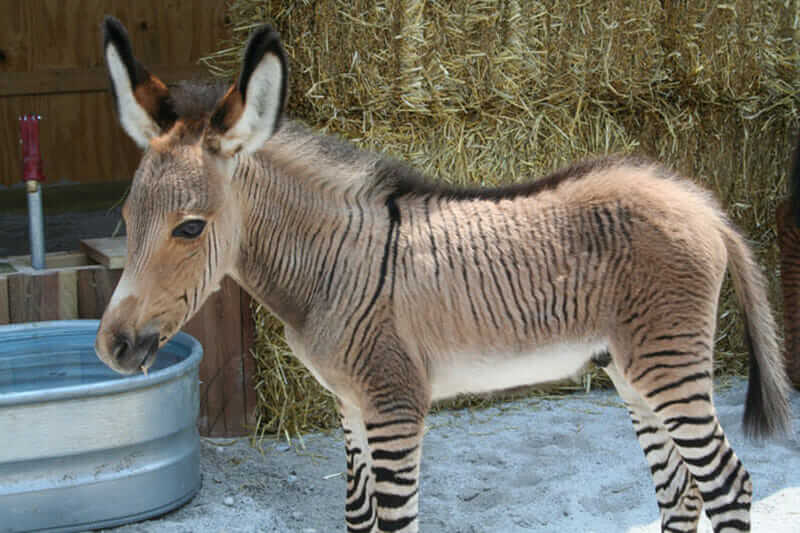
We didn’t make this name up; the offspring of such a union produces the unlikely, and rare, zebrass. Like most equine hybrids, the traits of the sire are generally more predominant. Such is the case with the zebrass, which usually sport fairly traditional donkey heads and torsos but look as if they’ve slipped into a pair of zebra print tights.

A zoo favorite, the zonkey is a relative regular in the hybrid world, likely because the hybridization has a higher success rate than most. Zonkeys have been bred since at least the 1850s and have captivated scientists, collectors and heads of state ever since.
In the early 20th century King Menelik of Abyssinia (now Ethiopia) gifted a zebra stallion to President Roosevelt. During the zebra’s time at the National Zoo he was loaned out several times to the U.S. Department of Agriculture for use in cross-breeding experiments. At least one of the results of these experiments showed up on the bill of the Sells-Floto circus.
Zebras are wild animals with evolved to survive defenses, they kick to kill and are dangerous. The only attribute to inspire cross breeding would be for its immune system and to create a pack animal that was hardier on the African continent. The variance in chromosomes make that complicated, first breeding Zebras and for ones that are most tame, that’s domestication and its never been done on the Zebra.
I think they should leave well enough alone. God doesn’t need our help and we often cause problems where there were none
The correct name for a horse/zebra cross is Zorse. The cprrect name for a donkey/zebra cross is Zonkey.